Jane’s* (not her real name) life had come tumbling down like a pile of blocks following a rape incident. “I was walking home from a friend’s place when a motorbike rider accosted me, pounced on, and raped me. I just wanted to die,” she said during the interview.
Today, Jane has gone through training in both soap making and bead ornaments, which she sells to the community, giving her a tangible income thanks to the Crime Si Poa mentorship program.
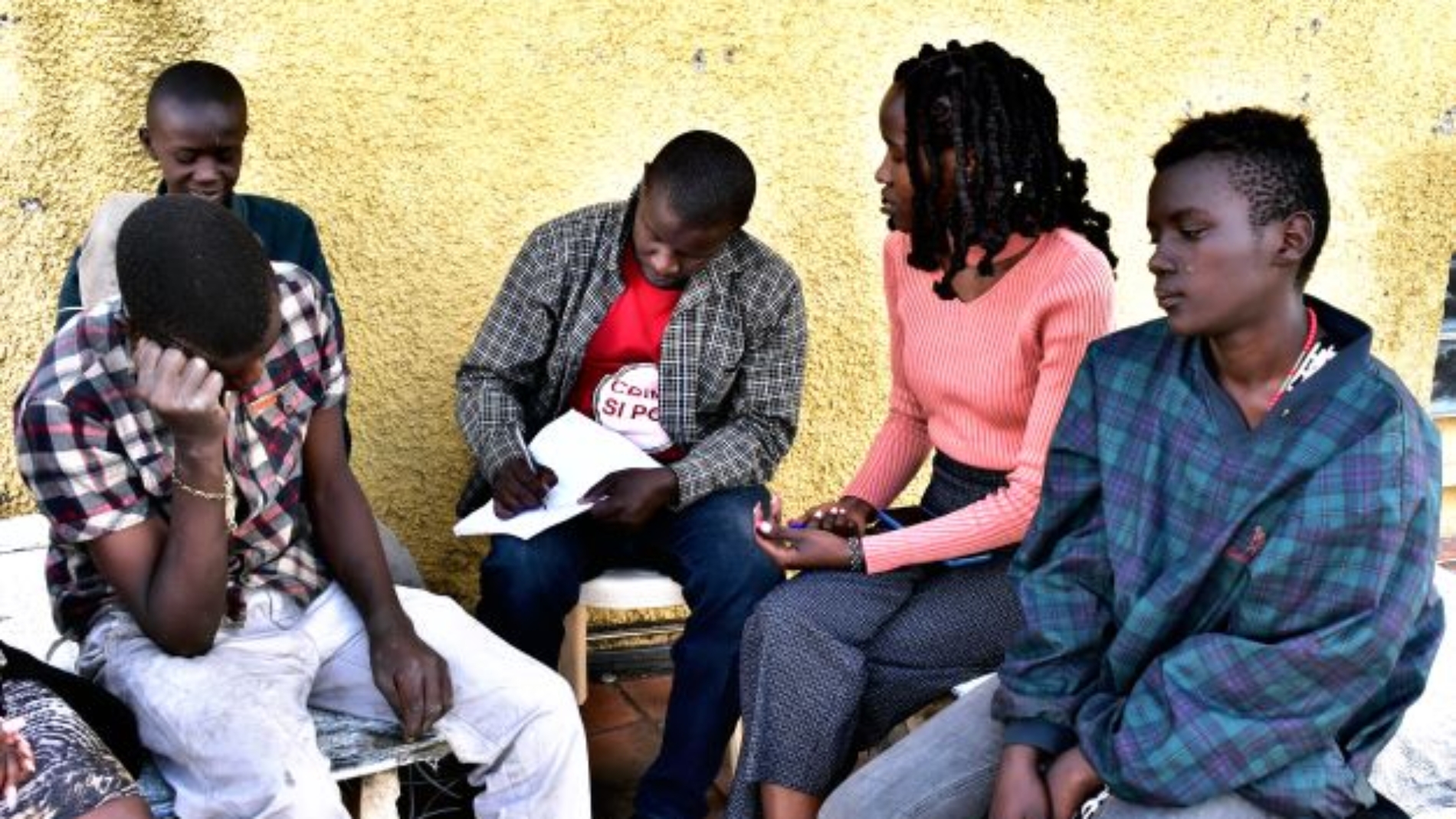
Jane suffered depression following the incident, becoming an alcoholic who harbored suicidal thoughts. She had refused to seek medical assistance following the incident that had left her traumatized, which worried her mother. “That is how we got to meet with the mother who shared the concerns with me,” says Rachel Mumbu, a trainer and mentor at Crime Si Poa who was conducting one of the community training courses on soap making. Rachels says Jane’s story was horrifying, and she needed urgent help.
After persistent persuasion, Jane won Rachel’s trust, opened -up, and was taken through counseling sessions. “The uphill task was to make her feel safe around me and allow me to walk the journey with her,” narrated Rachel.
The now-turned-counselor convinced Jane to allow a third party, Halima Guyo, Crime Si Poa Organization Kajiado County Project Officer, to assist her. They eventually took her to the hospital, where she received treatment and further counseling to overcome the trauma and suicidal thoughts.
She was later introduced to detergent and bead ornament-making as part of her healing process and as a source of income. Her transformation journey was remarkable.
Out of 175 countries, Kenya is ranked 114th in the World Population Review, placing it among the nations with high suicide cases globally. Rape has been described as a cause of traumatic experience that causes long-term outcomes, including psychological and social realms of survivors, which may end in suicidal thoughts.
Crime Si Poa has been creating community awareness to eradicate crime-related activities like rape, SGBV, FGM, and drug and substance abuse. The organization also conducts mental health awareness forums and economic empowerment programs that have enriched survivors such as Jane, giving them a second chance.
James Mutugi Wangechi is not a known name, not famous, at least not by the standards of fandom in the country. He is little known now, even in his neighborhood. That notwithstanding, he is on a mission to change the world with his hands, canvas, and some paint.
“I hail from a small slum called Mukuru Kayamba in Nairobi, Kenya. My family was dysfunctional, and it saw me get all the multifaceted person you see today.”
James started schooling at Pumwani high school, a journey he reminisces with nostalgia and some not-so-pleasant memories. He was from a dysfunctional family, not the normal one where one parent is active and the other is not; he was different. All the parents were absent! He had t learn the survival tactics all alone.
His relatives seeing how he was struggling with school and being alone with his mother, who was a drug addict decided. “ I was taken to a children’s home by an aunty who saw the agony and struggles that I was going through; I felt relieved for the moment.” His love for art was birthed here. He started with simple sketches, but it did not last long.
His cheeky behavior made him fall into the children’s home, and he ran away from class seven just before he sat for his primary education. “ I went to stay with my aunty, who had taken me to the children’s home. Although not well off, she managed to take me in,” he said. His love for art made him a name at Pumwani, where he attended his secondary school, and he said that he made money from skills that helped him offset some of his school fees in the first and second forms.
His delinquent side would catch up with him immediately after completing his high school education. He got into crime, and his aunty had to throw him out. “ I was a grown-up now, and I gave her no other option. She did what she could to protect herself and her kids.” He had nowhere to call home, and that’s how he ended up being a street-connected family. He continued his street criminal activities until the law caught up with him. He was sentenced to 10 years. This is where he met his longtime mentor Peter Ouko, the founder of Crime Si Poa, who counseled him against crime.
Like we all do when faced with adversaries, he needed a distraction, and his hope lay in the canvas and papers. It kept him going. “Canvas was like my therapy and the rehabilitation that I needed in my life; it embraced me” His inborn talent embraced him, and he started doing artwork seriously.
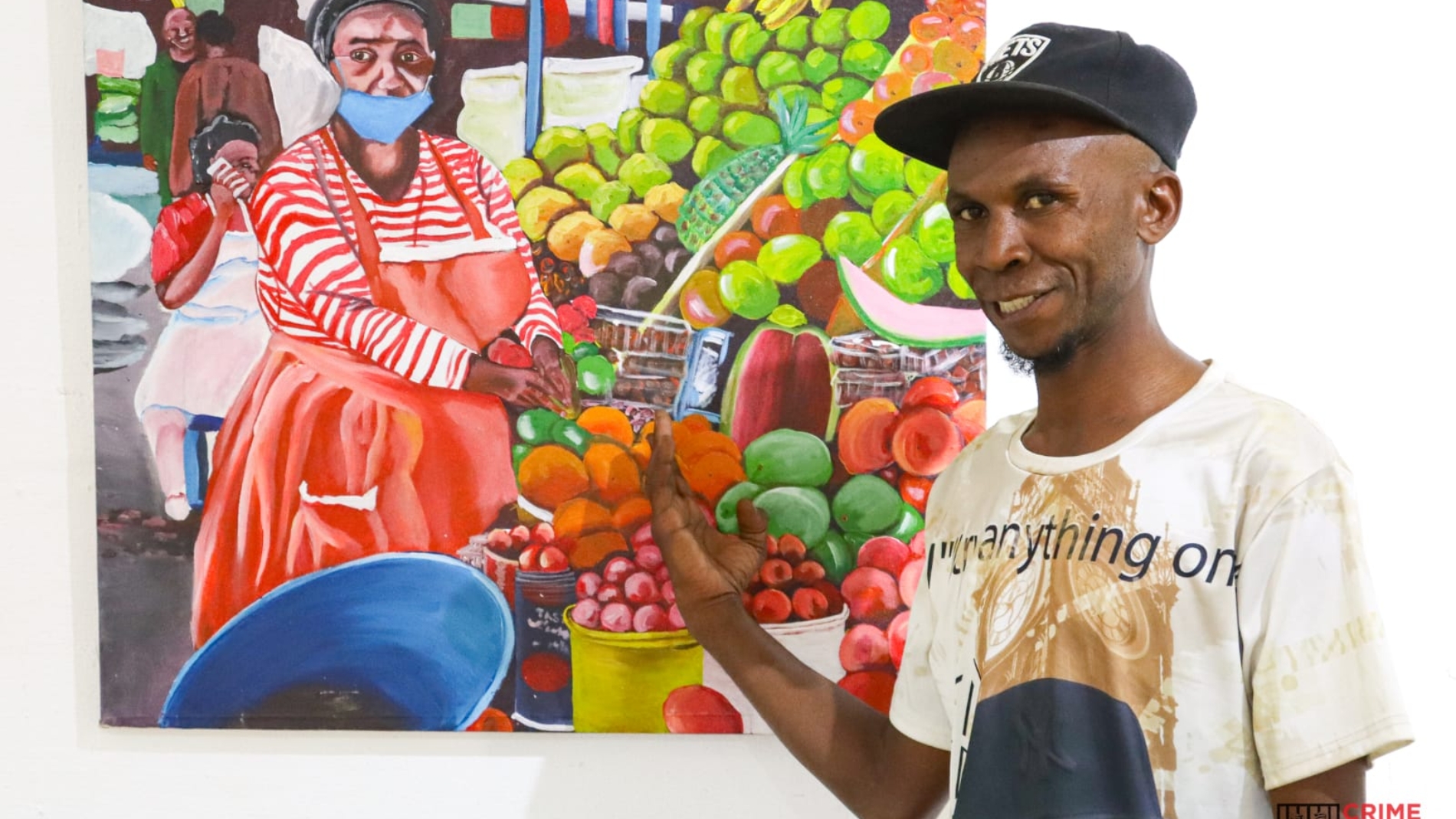
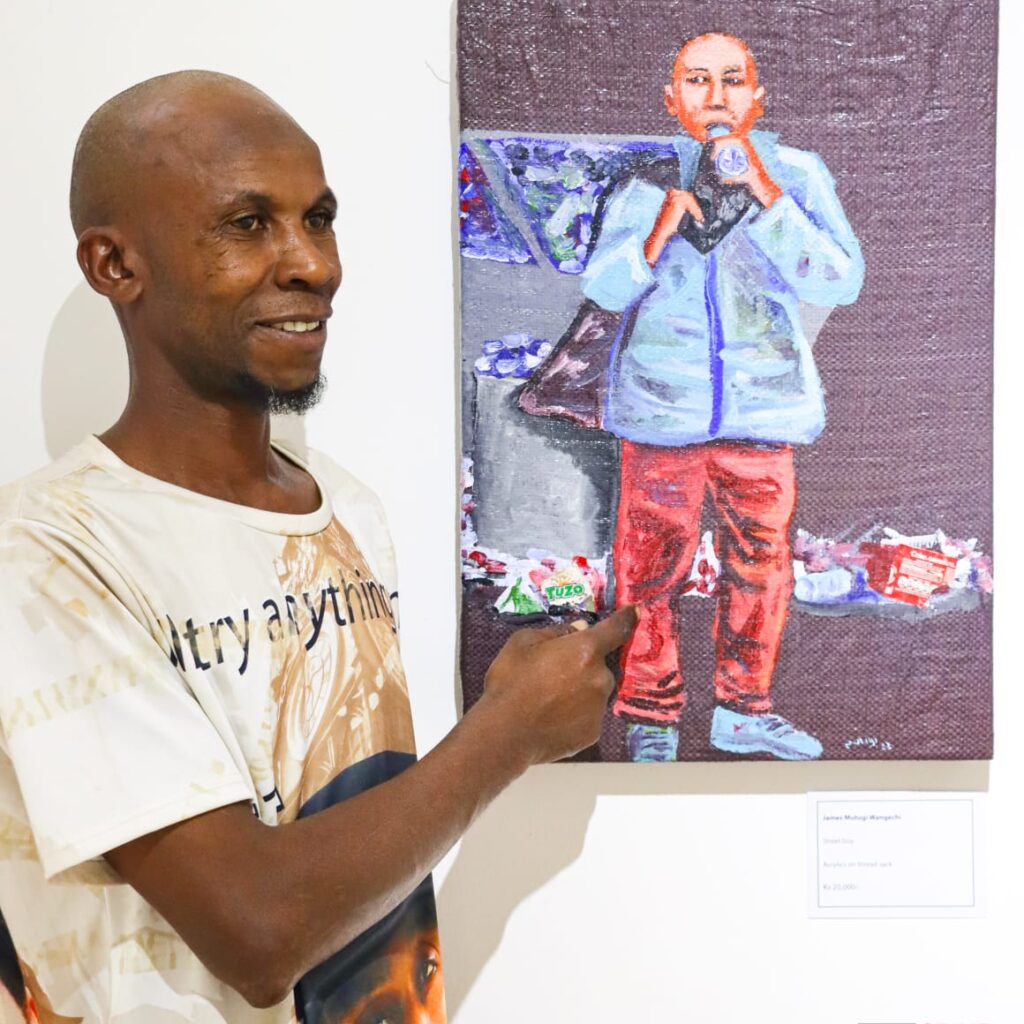
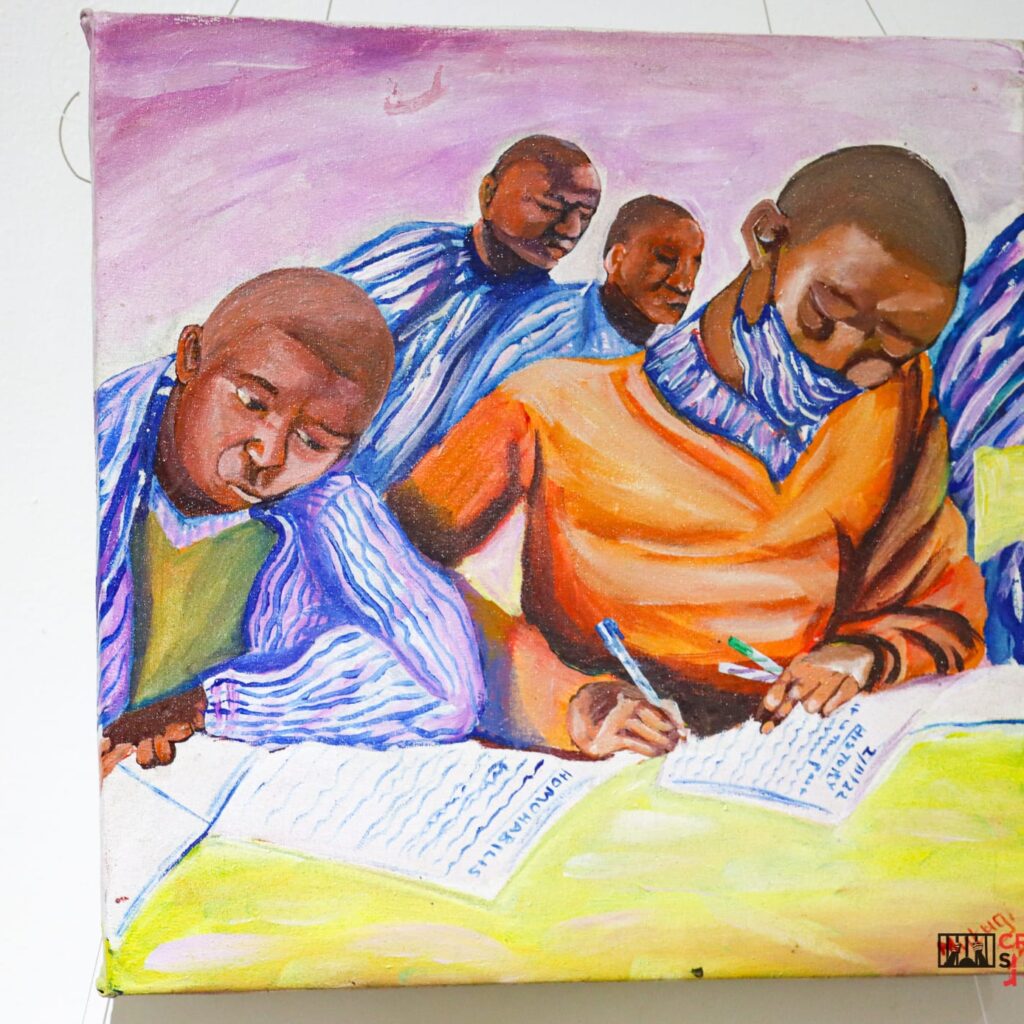
Today he paints to talk about police brutality, prevalent in African informal settlements, and social inequalities affecting the community. “I have also painted some of my life experiences and life happenings to those around me. My paintings are exhibited at the Kenya National Museum and Mukuru art club in Makadara constituency in Nairobi,” he noted. At 40 years of age, his paints have received global recognition and will be presented at Oxford University for a death penalty project workshop and conference.
In the pic James Mutugi poses with some of his artworks at the National Museum~Nairobi
He noted with apprehension that the Kenyan artworks are not yet entirely accepted as people perceive them as a rich man’s affair. “One day, you could be making a killing but then spend the next following months with no sales whatsoever. People who love and appreciate art buy for they know its worth. I would, however, love to see more people come and support the course,” said Mutugi.
In his free time, he mentors young and talks to young people about crime. Mutugi has been a crusader and grand champion of crime-free societies. He thanks Crime Si Poa for all the support he received in referrals and psychosocial counseling before being reinterrogated in the community.
As we left his museum, he also excused himself to go to another exhibition he was eyeing at Alliance Française; he is a man on a mission.
Purity’s journey from a young orphan living in a challenging environment to a successful receptionist in Dubai is a powerful testimony of hope, focus, and resilience. As an organization that encounters many young people from underprivileged backgrounds, Purity’s story stands out as a faith powerhouse that embodies the true spirit of perseverance.
Born and raised in an informal settlement called Gataka in Rongai, Kenya, Purity never got a chance to meet her parents, for she was orphaned when very young. “I may not describe anything pleasing about my early life as my peers do,” said the 23-year-old Purity.
At just seventeen and in high school, she got pregnant, and the baby’s dad could not take care of them. Trouble had hit home. “Hell broke loose for me, and I had to choose my next step. I quit school and started doing menial jobs to support my child as well as my aunt who I was then living with. I started working even before I could regain my health after giving birth,” Purity remembers with sadness.
Life had happened, and before she could rationally think of the next step, fate had mapped out her life like a movie scene and she ended up engaged to another young, orphaned man.
Their similarities had brought them together, but their dream of Romeo and Juliet moments died on the altar of newly added bills. “Life became unbearably difficult, and I had to go back to my guardian’s house as my then-partner could not sustain our primary needs. A 17-year-old would not have withstood marriage,” she chuckled.
Back at home, she learned about Crime Si Poa and the opportunities it offered youth from underprivileged backgrounds. She grabbed the opportunity as was enrolled in the very first cohort of the Digital Livelihoods class. She would attend classes in the morning and work in the afternoon to feed her son.
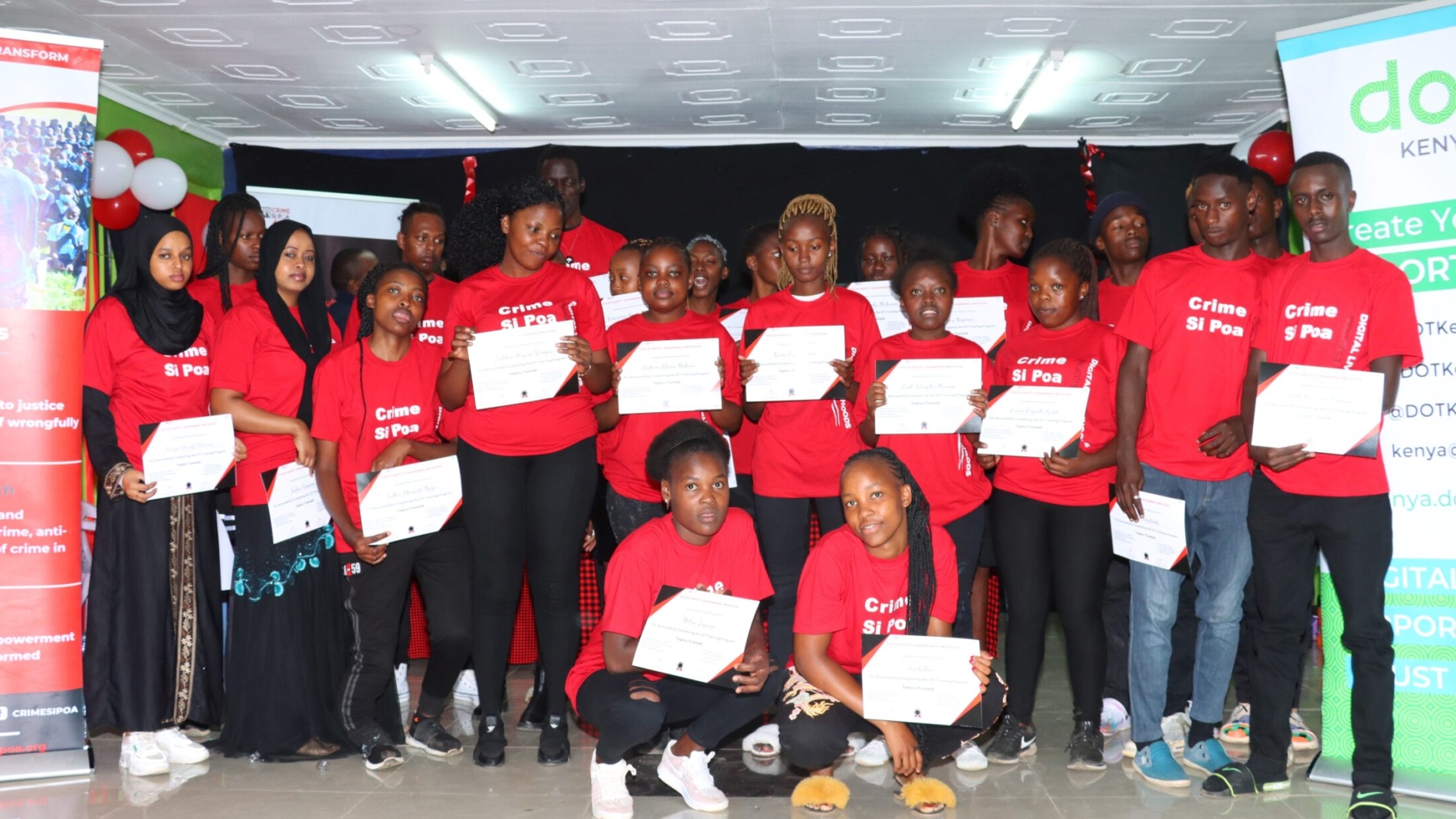
Purity’s fellow graduands display their certificates.
Even with this training, she still had an unquenchable desire that she wanted actualized; “I dreamt of completing my high school education, but the situation at home was not favorable.” She recalls. Talk of the audacity of hope; Purity approached and explained her desire to the Digital Livelihood Officer Phanice Kimutai as well as County Program Officer Halima Guyo, and together, they managed to get her a sponsor.
Thwarted dreams
“We had planned to take her back to school after the ICT graduation, which she greatly wanted. I could see her resilience when interacting with others even outside of class. She was destined to be more than her present condition,” narrated Phanice Kimutai.
From( L to R)Rongai Ward Administrator, Purity’s son, Purity, and Sylvia Morwabe, CSP Programs Director during the graduation ceremony.
However, there was an issue: “At home, when I expressed my desire to go back to school, it was met with resistance, and I knew that I was all alone,” said Purity. She was offered two options: to either go to school with her kid, (an impossibility) or discard the thought and if she went ahead to actualize it, she would have to look for somewhere else to stay.
She was shuttered!
Rekindled hope
Amid the desperation, she heard of opportunities to travel for work in Dubai which she applied for. “The certificate I had gotten from Crime Si Poa after graduation came in handy and placed me ahead of other interviewees. I passed the interview, and I could now smile.” Said Purity. Today, she is a successful receptionist at a hospital in Dubai, a testament to the power of perseverance and hard work.
“As someone fortunate enough to witness many young people transform their lives through the power of ICT and employability skills, I am inspired by Purity’s story. Her determination and unwavering faith in herself makes her a true powerhouse. And while there are many more young people like Purity who could benefit from the opportunities that we provide, the reality is that resources are often sparse,” said Phanice.
Purity’s story shows the need for more benefactors to support programs targeting young people from underprivileged backgrounds to acquire the skills they need to succeed and grow for bright futures.
You can support the Digital Livelihoods program on this page: https://crimesipoa.org/donate-to-crime-si-poa/
Muungano building Ongata Rongai was a hive of activities on 19th April as 28 students graduated with ICT and employability skills under the Crime Si Poa Digital Livelihoods project. The ceremony brought together various stakeholders in the digital industry who came to not only celebrate the students’ achievements but to also support them through advice on successfully navigating the digital era.
During the ceremony, Mr. Anthony Atuko from the Digital Opportunity Trust, urged the trainers to maximize their God-given talents and take advantage of the numerous opportunities available in the digital era. He opined that there are plentiful opportunities in the digital industry, and individuals willing to work hard and acquire the necessary skills can both excel and achieve their dreams. He also promised to absorb five of the graduates to train them in data analysis and mining, which are currently highly sought-after skills.
Anthony Chege from Ajira Digital under the Ministry of ICT also urged the graduates to embrace the steep learning curve in the digital industry and seek help whenever needed. “The opportunities out there require you to invest your time learning and getting the relevant tools.” He noted.
Students following the graduation proceedings keenly
One of the trainers in the fourth cohort- Kelvin Wavomba, encouraged the graduates to work hard and not give up on their dreams and ambitions. He shared his experience and emphasized that crime doesn’t pay and eventually catches up with an individual. This was a powerful message to the graduates, reminding them that hard work, resilience, and determination are critical ingredients for success in life. “You don’t have to engage in crime and end regrets like me, he said. see his story https://crimesipoa.org/echoes-of-hope/
Jackline Mugure, one of the program’s beneficiaries, was elated to have completed her high school education and acquired digital skills. She expressed her gratitude to Crime Si Poa for the skills they have imparted on her. Her mother, who was also in attendance, urged the young people to stay away from delinquency and criminal activities and focus on building their future.
Crime Si Poa’s Digital Livelihoods officer Ms. Phanice Kimutai, congratulated the graduates urging them to share the skills they have acquired with others who were not as lucky to be in the program, thus extending the program’s reach beyond the 28 graduates.
Our senior Programs Manager Ms. Irene Were presenting a certificate to a graduand.
The digital livelihoods program is a testament to the fact that digital skills are essential in today’s world. The program has equipped young people from underprivileged families with employability skills in the previous three cohorts, making them marketable in the digital industry. The support from stakeholders in the digital industry and partners makes the already-in-demand training viable. To support the noble cause, visit https://crimesipoa.org/donate-to-crime-si-poa/
An endearing, jovial smile hidden in a reserved and shy mien is the first impression that hits you when you meet him. An intern ICT trainer at our digital livelihoods department who has been impacting young people from the underserved areas of Kajiado County with ICT skills, his mastery of, and prowess in software development and computers is mesmerizing. He exudes an aura of serenity and a pinch of nerdiness. Meet Kelvin Wavomba.
His eyes betray a raw determination and willpower, born of adversity in life, to be great in life. He was not always like this he says.
Fate turned Kelvin into adult life long before he could stop being a child. “Life was not rosy growing up and I was constantly at home due to fees.” he nostalgically recalled. That however did not deter him from getting cluster points to join higher institutions of learning. Through the help of well-wishers and access to limited bursary funds, he was able to finish his high school education “I got a C+ grade, something I had not anticipated with the challenges I had gone through. Even though I was relieved, I knew it was not my ideal grade,” Kelvin says.
He had passed the first hurdle and the next waited- there was no fees for his university education. All he could cling to was hope, hope that help will come. “ I had to think fast on what to do, and without any papers for a formal job, I ended up as herder earning ($30) three thousand shillings monthly,” he said.
Even though Kelvin knew that herding was not his calling and he would eventually transition to something big in the future, he had no idea what that “something” would be. Call it an audacity of hope driving his desire to move to look for big opportunities. After working for three months, he quit his herding job and with Sh.7,000 saved from his salary, moved to Nairobi.
His destination was Kawangware commonly known as ‘Kakamega ndogo’. “I did not know anyone in Nairobi, leave alone Kawangware, but I wanted to be there. I had been told that would be like my second home,” he narrated. With his little savings going to renting a room, the next nightmare was how to get a job to maintain himself. Lady Luck gave him an immediate smile, because after just a week, his next-door neighbor alerted him of a guards’ job which applied for and got.
The immediate success birthed greed. He wanted to grow fast, rules notwithstanding. He fell afoul of the law and was soon on the radar of crime busters. The proverbial fortieth day arrived sooner than he expected, and when the sleuths called and asked him to surrender for interrogation, he decided to go on the run. He was a fugitive from justice. “I had bought a few computers to set up a cybercafé back home as my exit plan, hence my decision to run. ” he continued.
It started raining and before he could know it, it was pouring. His cybercafé was wiped clean by thieves just after a month of operation. He could not also hold phone conversations for more than thirty seconds and lived in perpetual fear of being traced and arrested. “After the burglary in my cybercafé, I knew that I could not fight or run anymore. I just did not have the energy. My time was up.” Kelvin notes while in deep thought. He however, for two years, managed to evade the dragnet laid for him. “When the investigations officer called next, I surrendered and made my location known to them. I was duly arrested the day after this phone call.”
At his trial in court, he pleaded with the Magistrate to allow him to go back to school as he was a first-time offender. After a two-month stay in remand, the Probation officer tendered a favorable report to the court, and he was given a conditional release. The Probation officer then linked Kelvin with Crime Si Poa who financed his entry to a Technical College where he is pursuing a Diploma in IT.
Jovial Kelvin at main office perusing files during digitization of finance department.
“Kelvin’s story was different. There was something unique about him and I knew that he had reformed. He stood out as determined and we could not deny him the chance to reboot his life,” stated Ms. Flavier Mwika, the Prisons and aftercare Program Manager at Crime Si Poa. “We support returning citizens (ex-inmates) willing to go back to school like in the case of Wavomba,” she added.
Kevin has not only proved to be an innovative and stellar student leader in his college, but has been , during his long holidays, interning with us at the digital livelihood project in Kajiado County where his teaching skills stand out. He is deploying his passion to help and mentor young Kenyans on the adverse effects of crime while equipping them with employability skills.
“My past does not define me, and I am way better than I was back then. On the flip side I would not have known Crime Si Poa who have been pivotal on my growth journey,” he said. “ I urge them to devolve all these services they are providing to the villages where many people are ignorant about the law,” Kelvin confidently says.
With our interview ended, Kelvin, the now tech guru, excuses himself to go back to the Finance office where he is helping digitize records. I can’t wait to record his next journey in life.
About our Prisons and Reintegration Program (Phoenix) – Phoenix deals with the well-being of inmates through well curated psychosocial, spiritual and life skills mentorship sessions within in prisons and aids in their reintegration back into the community upon release.
When the Crime Si Poa community outreach program team met street families at Ngara Nairobi, something stood out on this day; a young 15-year-old shabby-looking but focused boy, AK.
His looks and demeanor betrayed the fact that he had not stayed in the streets for long, his indifference notwithstanding. It is however his introduction that caught our rapt attention. The boy from Central Kenya had only one desire: “I would like to go back to school and become somebody someday. This is not my life, and if I have an alternative trust, I will leave it,” he said amidst teary eyes.
Programs Officer Ruth Wambui poses for a selfie with AK on his admission day.
“How then did you end up in the streets?” asked Ruth Wambui, Crime Si Poa Programs Officer in charge of Nairobi County. With unease and apprehension, he narrated how an adult had sent him to neighbor’s house to commit a crime. The young man was charged alone and ended up at a Borstal Institution for six months.
Upon his release, his parents, who worked as farmhands, refused to take him back fearing that he had not fully reformed. Stigma ran high! A.K had no one to turn to, and the correctional services could not retain him upon his sentence completion. “My father said that I was not welcome home as I stood to bring him bad luck, and he could lose his job,” said A.K. “The street was my last resolve, and it became my home,” he continued.
Armed with this information, our team through the street family reintegration project contacted his dad, who confirmed the story and flatly refused to take back his own son. “He is now a grown-up and can look for menial jobs like other men and support himself. We cannot have him back,” the dad curtly said, ignoring the fact that his son was still a minor.
“A. K’s story touched me, and I became restless. I knew I had to do something, and with the help of social services officer in Ngara, we found a shelter for rehabilitated boys,” said Ruth. The center, however, was just that, a shelter. “The first step had been done, and we had secured him a roof over his head, but then he needed schooling, which the institution does not provide,” Ruth added.
Despite having stayed in the streets, A.K managed to ace the entrance interview for admission to Muthurwa Primary School and is set to sit for his Kenya Certificate of Primary Education (K.C.P.E.) exam later this year. The school headteacher has great hope in A.K and is sure he will perform well. “He is a well-mannered boy who is determined. We will assist him in all the ways that we can to ensure that he performs well in his forthcoming exams,” he said.
Programs Officer Ruth Wambui poses for a photo with AK on his after a successful admission at Muthurwa Primary School.
“A. K’s story inspires us to keep the fire to change communities for the better burning. We strive to change one life at a time. However, due to the big need and limited resources, we are calling on more people and partners to support this noble cause,” said Ruth. She further thanked friends, donors and supporters of Crime Si Poa work in the streets and the communities.
About Borstal Institutions:The Borstal Institutions Act (CAP 92) provides for establishing borstal institutions and the detention of youthful offenders. The Act defines a youthful offender as a person who has been convicted of an offense punishable with imprisonment and has been found by the court, at the time of such conviction, to have attained the age of fifteen (15) years but to be under the age of eighteen (18) years.
As the day was breaking on Friday 27th Jan, Joseph Kang’ethe knew that his long-awaited day had arrived. He could smell the freedom that he long desired for almost two decades that he had been behind bars. He had dreamt of this day and even fantasized about it all the time in his mind. He so long desired it.
And at midmorning, the gates of Nakuru men’s prison squeaked slowly and opened him to the horizon of all possibilities where he could see all the things that he had hoped and dreamt of past the prison walls. This was it! With just a suitcase containing his clothes and with a novel in hand, he took the first step towards his freedom. Mr. Kang’ethe was arrested in 2005 but he remained on remand up until 2009 when he was convicted and found guilty by a court in Molo.
(Pic. Kang'ethe leaving Nakuru Main Prison)
In prison, he had taken up vocational courses which he hopes will help him gain income and speed his reintegration. “I have gained skills in metal works, leather works, and also tailoring which I hope will come in handy when I settle at home,” said Mr. Kang’ethe while addressing journalists outside the prison gates.
With the glaring fact of inadequate resources, he called on well-wishers to help him get a sewing machine so that he can also teach other young people how to sew as he gets his livelihood. “I will start my tailoring shop and I ask people of goodwill to help me get a sewing machine, I want to pass this knowledge to young people as I caution them against engaging in crime,” he noted.
Prison officers described him as a reformed and reliable man, traits that saw him granted the coveted “trustee” status in prison. (A trustee is a trustworthy and well-disciplined inmate who leads and mentors the others to ensure order in the daily activities in prison.)
Joseph was one of the Crime Si Poa beneficiaries in Nakuru Men’s Prison. He religiously attended the pre-release psychosocial and wellness classes run under our prison centric Phoenix program.
“Crime Si Poa has helped in my stay in prison, and they told me even when I go back home, I should strive to live harmoniously with others and stay in peaceful environments,” says Joseph.
A senior Prison Officer, Superintendent Odera described him as a transformed man: “I am happy and glad that Joseph is being released from Prison as a reformed man. We had elevated him to trustee status when he was here in prison,” he commented. “I urge the community to embrace him fully as he is transformed so that he can share his skills with other people.” Stated SP. Odera
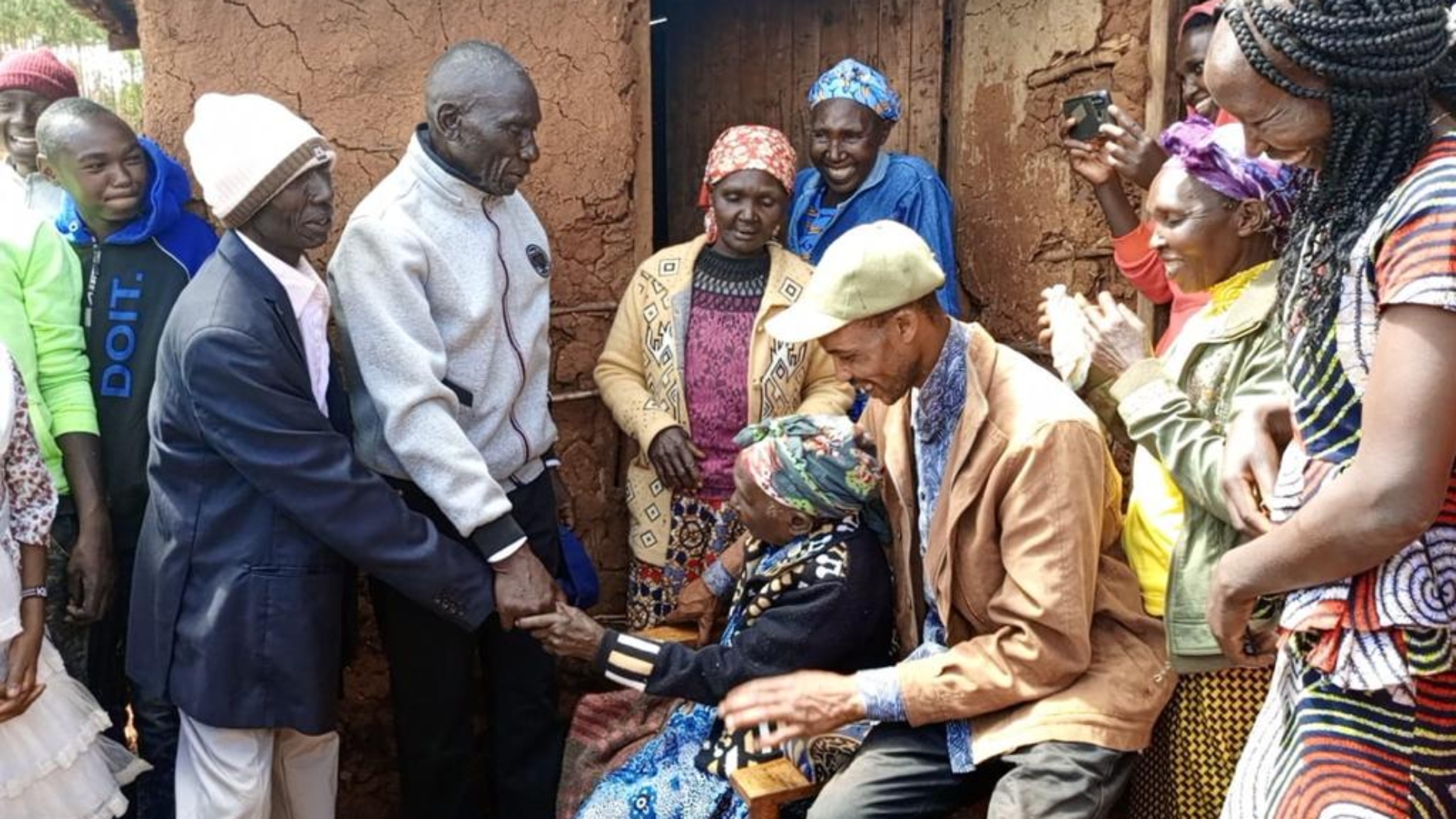
After a 3 hours’ drive from prison accompanied by prisons and Crime Si Poa officials and battery of journalists, Joseph was received with jubilation and dances at their home in Kuresoi North. Overjoyed family members and friends could not hide their joy as they embraced their lost son who had been behind bars for almost 20 years. His 95-year-old mother was particularly delighted to see her son. “I’m glad that he came back home when I’m still alive and I can see him,” she said.
Crime Si Poa Phoenix program works in prisons and Borstal institutions in concert with the Prisons welfare and spiritual departments through a package of services including spiritual and psychosocial support, mentorship, entrepreneurship training, legal awareness and support services and talent development amongst others. This is all geared towards the reformation of those who have been in conflict with the law and their subsequent reintegration into the community upon release.
We thank our partners and The Answer Foundation for their support in the program
Ian Alulu’s story is one of resilience yet with hope and a true definition that all is possible in the spectrum of life. You will be wrong to judge him by his past rather than the future he anticipates.
Born a firstborn in a family of seven, he felt obligated to help his family. He felt that he was a burden to his parents and saving them the extra plate of food would go handy and a long way for the siblings. It’s a societal problem that many firstborns in African family setting face. They get accustomed to the reality of life that they are supposed to be responsible for their siblings and in most cases at their expense.
At form one at barely 16 years of age, he was ready to do that. Trade his precious dreams for the future comfort of his siblings or even ensure that there was more food for his siblings or afford a meal a day without bothering his parents who already had the burden of taking care of the other siblings.
Armored with nothing but hope and optimism, he hitched a plan to go to the capital city – a city under the sun where all people are given opportunities, and everyone seems to do better for themselves. I’m sure if not certain that’s the narrative that is sold upcountry that there is there are opportunities and ready money. Well, it’s true Nairobi is inhibited by two classes of people; those with the means and those who think they have. Ian dreamt of falling into the haves someday, maybe not soon but he hoped. Ian was sold hope that there was ready manna in form of a farmhand job that awaited him at the other end, all he needed to do was just to bring himself Nairobi and the rest would fall into place. “I was told that there was a farmhand job (shamba boy), and a man would pick me up in Nairobi,” recalls Ian.
The only means that he would have chosen to use and comfortably afford to get to Nairobi; would have been walking but, walking for over 300km and the urgency of the employment walking ruled out of the picture. He however needed to be in Nairobi come rain or high waters. On the escape day, he prepared to go to school as usual. Unknown to the parents this would be the last day they would see him in the few following months. They would be months of agony but then, they had other kids to take care of and all they could do, was to hope that he would land well and hope that someday he will go back home and maybe carry goodies with him. The plan was in place. “I walked to school that day but immediately went home, got a change of clothes, and changed at our neighbor’s compound,” he reminisced.
He hacked a lift on long-distance lorries and that’s how he landed in Nairobi. He would later be met with the horrible yet harsh reality that his job had been given to someone as he had arrived late in Nairobi. What would he have you expect from a lorry? As the reality set in, he realized that he had to survive. He needed basic living needs food, shelter, and clothing. But then again how do you survive in a capitalistic country without a job? A city where your neighbor will cook, and you will see them eating without bluffing on your sight? He was not accustomed to this in the village, but again life is a teacher, and this had become his reality. He learned that Nairobi is a city where everyone exists for themselves. That’s the reality that faced him! He ended up in the streets. That’s the only affordable place he would get but even with that, he needed to eat and cloth. Necessity invented a solution. He started working as a menial worker, carrying luggage for passengers at bus stops and when business would be down or when luck allowed, he would look for scrap metals and sell them at KSH 30 a kilogram, or roughly $0.30. in a city with over one thousand street people doing the same in a city with no steel manufacturing factories, he was bound to fail. “it’s difficult to get a kilo of scrap metals as many of us are looking for the same, that’s why we end up in carrying luggage to compensate on that.” He spoke.
He lived in perpetual fear as there was constant friction from the county officers. He lived on a thread for he did not know the hour or the day the county enforcement officers would descend on them. They would chase them from the streets all the time. He particularly remembers a fateful incident, “they once chased us at night and it was raining, I had to salvage my beddings and run. They ended up being soaked in rainwater, it was my worst night,” he narrated, “I thought I would contract cold-related diseases and die, I was afraid,” he remembered.
He had a strong or you would call it nostalgia for home but again he had left without a goodbye. He was afraid that his parents would not take him back. Crime Si Poa through its street kids’ program under community engagement, managed to get to know him, by then he had adopted David as his street name. Life had served him the reality and when he heard and learned of the program through social welfare carried out by Crime Si Poa, he was more than happy to engage when he was asked whether he would want to go home back to his parents though hesitantly he agreed.
CSP with the help of a chief in Kakamega ensured a seamless reception at home by tracing his home and talking to his parents and community. He got reintegrated into his family. His parents could not hide their joy may be due to the return of their lost son.
Today Ian is in the process of getting back to school, this time he is resolved more than ever that he wants to go back to school. His and many others are stories that inspire CSP to keep changing the world through little efforts, brick by brick to ensure a society that is changed and just to all. Ian needs school fees; he needs a small stipend for his personal needs. We can’t do this alone. Kindly partner with us and help him and many others to have a dignified life and change the story one story at a time.
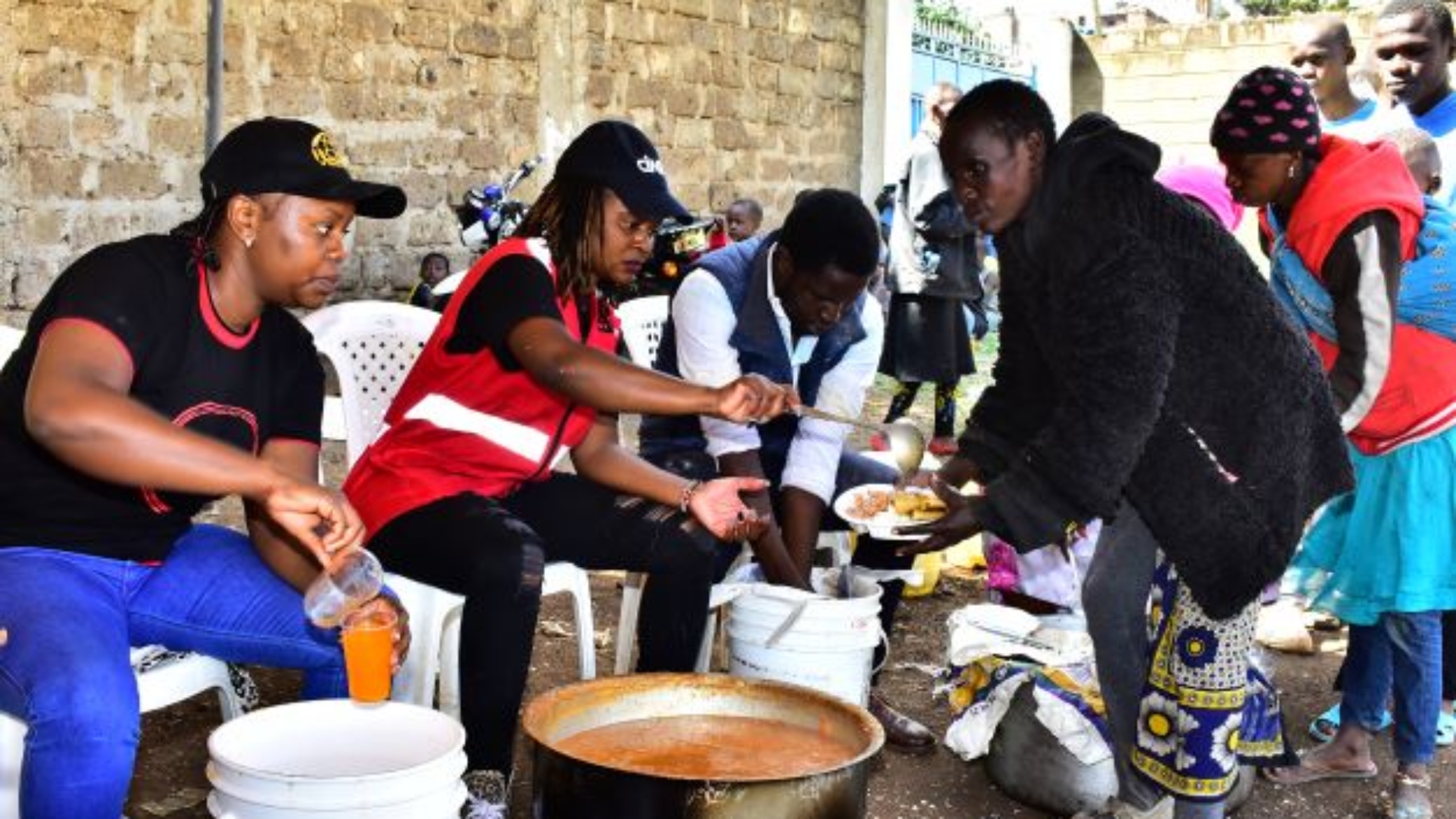
Sharing a meal is a global language, and it is in the spirit of the festive season that Crime Si Poa (CSP) staff, as part of their day of service, partnered with the Street Changers CBO to hold a colorful event for more than 500 children and persons living in the streets of Nairobi.
During the sports, mentorship and food festival held at the PCEA grounds in Eastleigh, Nairobi on Friday, street children and families from Eastleigh, Huruma and Mathare areas of Nairobi were fed sumptuous meals and given clothes as the Christmas festive season sets in.
Speaking at the function, Crime Si Poa Programs Coordinator, Ms Irene Were reiterated the importance of the exchange and learning platform and what it means to persons living on the fringes in society.
“Crime Si Poa runs a street children project in Nairobi, Nakuru and Kisumu cities respectively which involves elements of psychoeducation to address the mental wellness of the beneficiaries, soft skills mentorship and life skills training. This has led to successful re-integration of some of the beneficiaries to their families,” said Ms. Were
Ms .Were reiterated that as an organization that works with street families, Crime Si Poa believes that such events show true love while at the same time encouraging acceptance and inclusion of the street families. This in turn reduces crime rates and makes our cities and neighborhoods safer.
The fun filled event involved multiple activities including; guests cooking, street families and community members engaging in a soccer tournament mimicking the ongoing World Cup, and counselling sessions on drugs and substance abuse.
Mercy Murithi, the Coordinator of the Street Changers CBO acknowledged the enormous talent harbored among members of the street families that needs to be explored. ‘‘The amazing football game witnessed here today can be harnessed to elevate the lives of street kids, rehabilitate them, and help to ease the reintegration process with their families,” she said.
Representing the government, Eastleigh area Chief, Edwin Muchere noted that hard economic times have driven many vulnerable children to the streets. He requested more organizations and community members to show empathy to street families emphasizing that we should all enjoy equal human rights.
“We can make the world a better place when we all care for one another regardless of our status in the community. I usually request security people guarding different shops in Eastleigh not to harass children and instead treat them as fellow human beings,” Muchere stated, adding “It is not their choice to be in the streets we should exercise humanity, the fact that they have torn clothes does not brand them thugs to warrant beatings.”
CSP thanks our sponsors the Schooner Foundation for their great support in changing the lives of the underserved in the community.
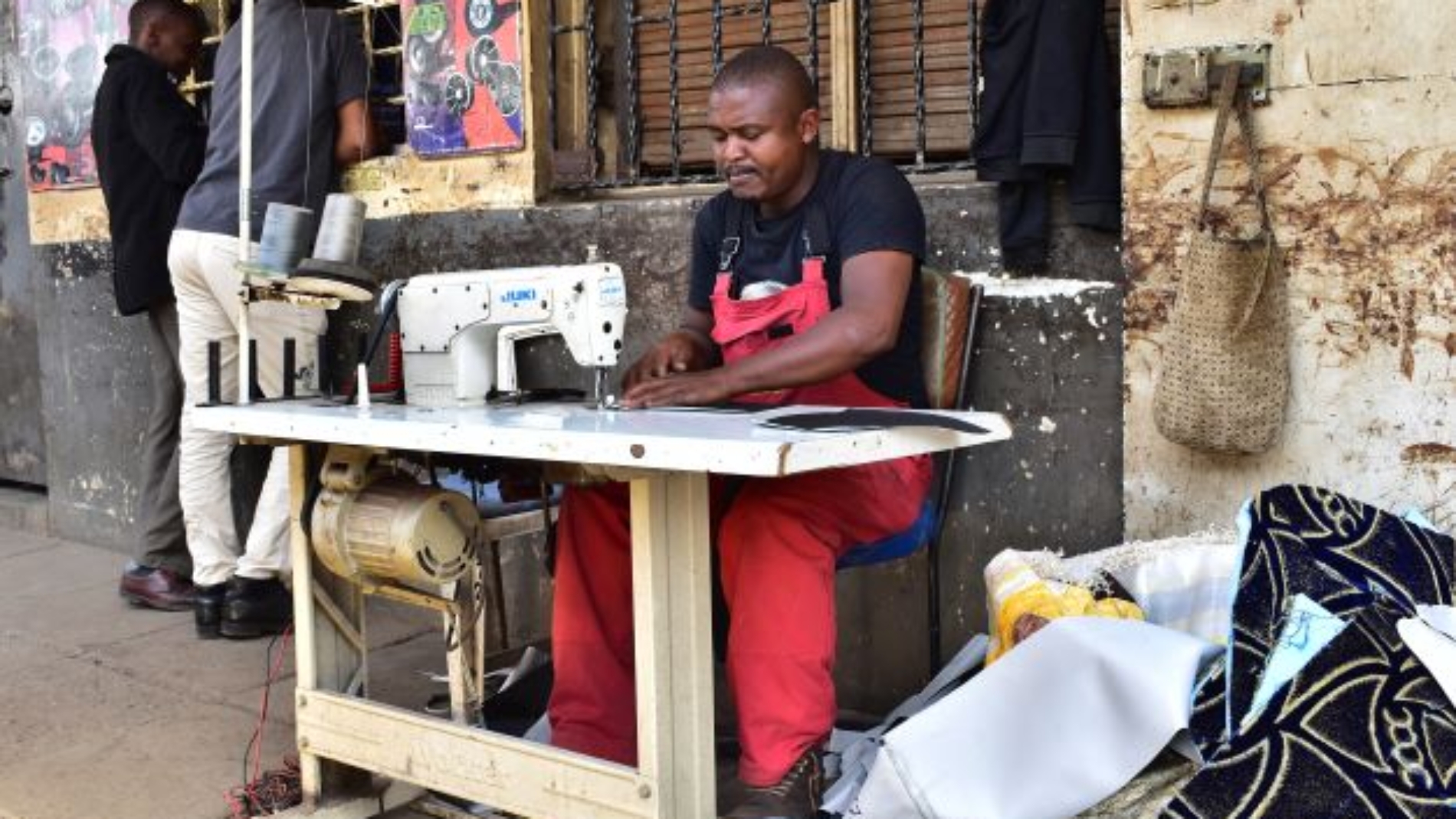
The sewing machine is purring as another order for a customer is being put together. It is only two years since James Macharia walked out of prison after serving a 15-year sentence, and though the transition from prison life and back into the community was tough, James has put all that behind him and is gainfully putting to practice the sewing skills acquired while incarcerated.
Even though there is a presumption that sentences served are commensurate with the offence one is convicted of, and the Kenya Prisons Service prides itself as a correctional service of excellence in Africa and beyond, the reality is that Macharia, just like many other returning citizens (ex-inmates), find it difficult to get jobs or even finances to start business upon release to due to the much dreaded “certificate of good conduct” from the Directorate of Criminal Investigations (DCI).
“After serving many years in prison, I faced a lot of challenges including stigma when I was released. The hardest part was getting a job or even money to start a business with the skills I had acquired. I knocked on various office doors with hopes of getting assisted to acquire an electronic sewing machine in vain. In most cases all I got was empty promises,” reckons Macharia.
According to Macharia, days quickly turned to weeks, weeks turned to months and months to a year, without securing any financial help to start a business to sustain his livelihood. He had whoever vowed and determined to not give up or allow himself to relapse into crime as an alternative to earn a living.
“I almost lost hope, but when I remembered how far I had come from my former life in crime, I decided to push harder. Sometimes you feel like doing the unthinkable, but you realize that crime doesn’t pay. I choose to approach Crime Si Poa, an organization that was founded in prison and which is now creating change in the society. This was a game changer and a beacon of hope to me,” said Macharia adding “To date, I remain grateful for the financial help I got from the organization.”
Crime Si Poa through its empowerment initiative program granted James Macharia, financial assistance to purchase an electronic sewing machine that quickly helped him realize his dream of becoming an entrepreneur.
Born and raised in Nairobi, Macharia was able to quickly identify a niche for a proper location for his business and establish a customer base. His decision to start his business in the busy Jua Kali area of Ngara, aided him to tap into the thriving matatu industry.
“I have skills in sewing attained while in prison. When I got out of prison, I didn’t want to waste the skills. I am happy that today I have a customer base around Ngara area in Nairobi. Most of the cool seat covers in Matatus are made by me. This makes me feel satisfied,’’ Macharia said.
Through partnership with The Answer Foundation, a Dutch based Christian organization that focus on holistically empowering inmates and ex-inmates through spiritual, pyscho-social and employability skills, returning citizens like Macharia, have secured a second chance in life, and are now also offering job opportunities to other Kenyans. This not only helps reduce recidivism but also leads to reduced crime rates in society.
Other than sewing and upholstery, the multi -skilled Macharia is also NITA certified mechanic, carpenter, and welder. “I am requesting those who have got jobs, to bring to me as I am qualified while my charges are pocket friendly,” concluded Macharia.
Crime Si Poa has always been on the front line of empowering returning citizens, to ease their reintegration into society.
James is proof of resilience, audacity, and focus. A model citizen worth supporting. You may call our office number 0741506060 if you want to place orders to, or support James.